Musing on Achievements
Xbox’s Gamerscore Achievements system quietly turned 20 this month. That’s two decades! I’ve been wanting to write a piece about Achievements for a while because, frankly, they’re one of the more interesting things to ever happen to video games.
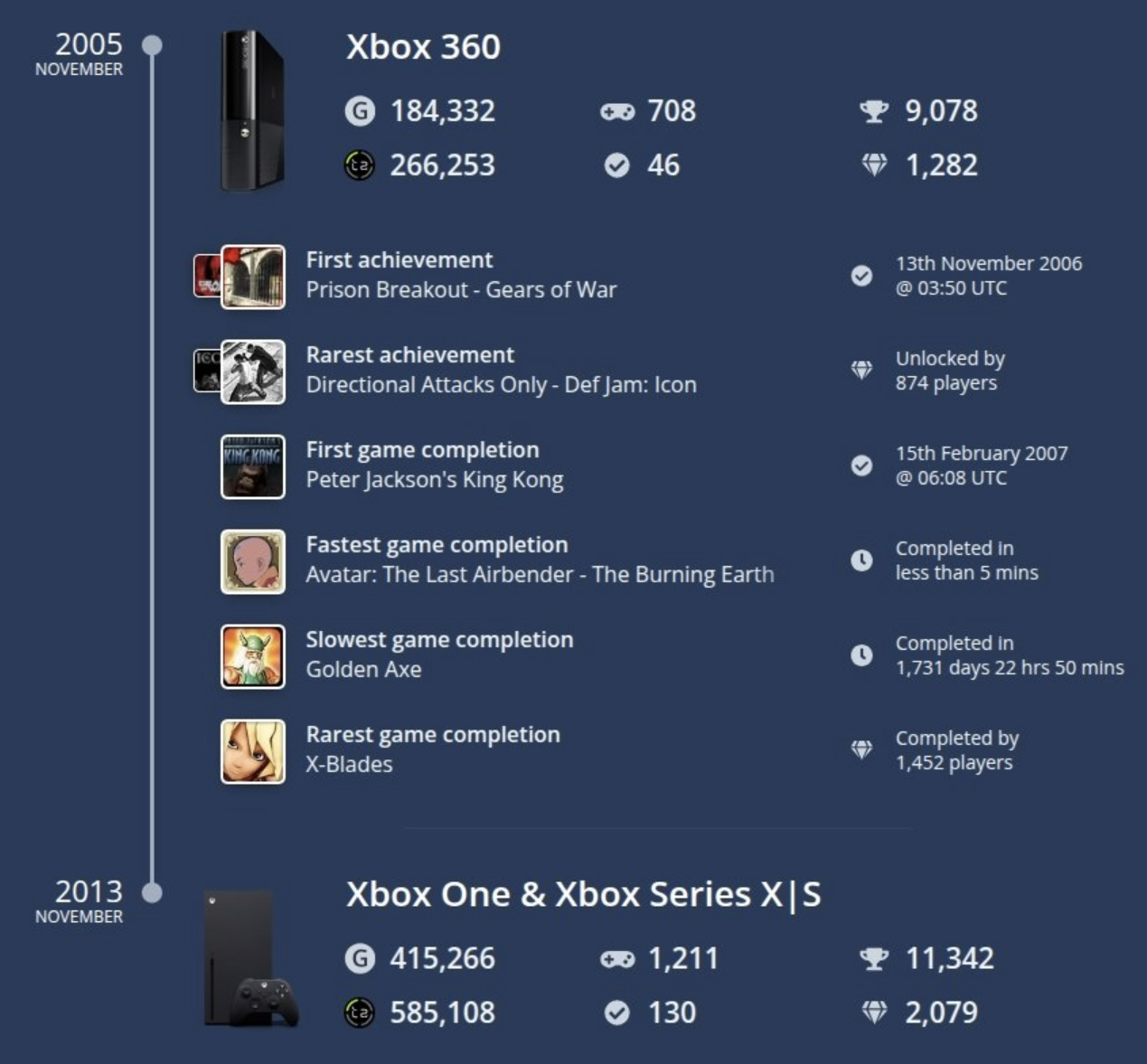
At their core, achievements (or trophies, badges, stickers, whatever noun your platform prefers) are goals defined outside the game, inside the ecosystem they belong to. Because of this externality, they are thought of as meta-goals. Typically, there is no in-game reward for completing these. Instead, the reward comes from “growth” in the player’s profile. So, in the case of Xbox, each achievement has a score which accumulates into the profile’s Gamerscore value. However, this is not the only type of growth that could motivate a player to earn achievements. Growth in the player’s profile comes in many flavors and also includes:
- Completing a full set of achievements for a specific game
- Unlocking infamous or brag-worthy achievements
- Earning rare achievements that few gamers have unlocked
Personally, the kind of growth I enjoy from these systems is akin to scrapbooking. I simply like collecting achievements, flipping through them like a digital photo album of my gaming history. So many are tied to vivid memories: where I was, what I was doing, and with whom, when some janky achievement finally triggered. Because my profiles also track play history, the whole thing forms a surprisingly accurate portrait of my gaming taste and personality.
As the years have passed, different statistics have been used to generate different measuring sticks when it comes to achievements. External websites like TrueAchievements and PSNProfiles track all sorts of player data: ratios, rarity, leaderboards, streaks, and more. They host meta-competitions and other activities that creatively use this data. Entire communities now exist around achievement hunting, full of players ready to help each other perform obscure tricks or orchestrate elaborate boosting rituals.
Regardless of why people chase them, Achievements undeniably changed how many gamers play. The usual stance is that Achievements gently push players toward experiences they’d normally skip, stretching a game’s lifespan and value. But I have an interesting theory as to why Achievements came about the way they did.
Bragging rights are ancient. What was new and compelling was embedding that bragging system at the platform level. When Microsoft did this, they created one consistent truth: every game on the platform has the same intrinsic value in at least one dimension.
Not all games are equal. Some score 9/10, some score 1/10, and players behave accordingly. We spend money on good games and we avoid bad ones. Achievements are the great equalizer. Every game, no matter how obscure or mediocre, can increase your player profile value.
It wasn’t always consistent; early Xbox 360 titles had wildly different achievement totals until Microsoft standardized the 1000 Gamerscore baseline. So even if you buy a game you don’t like, you can still increase your profile’s achievement count and Gamerscore value. Of course, this means many gamers out there will buy and play anything for this growth; some publishers have capitalized on this, putting out games with achievements that are quick to earn.
To support the idea of Achievements being an equalizer, we should look at its forgotten subsystem called Challenges.
Challenges were time-sensitive achievements with tangible rewards like wallpapers or bonus items. They actually expired, never to be earned again, and there hasn’t been a new one since March 2024. Where Achievements say, “Everything has value,” Challenges said, “Buy now or miss out.” A few Challenges were built around playing within the first week of launch, with names like “I Was There” and “Day One Hero.” A lot of games these days survive on FOMO or Fear Of Missing Out, and the Challenges system would have thrived the same way.
Why didn’t they survive? A mix of possibilities: Xbox One’s rocky launch/poor adoption, unappealing rewards, poor dopamine payoff, or simply the fact that Challenges didn’t accumulate like Achievements do. They were ephemeral in a system built on permanence. Still, they reveal Microsoft’s dual motives: Achievements support broad value (“Get it anyway”). Challenges supported urgent value (“Get it now”).
Consider Evergreen titles: Fortnite, Roblox, and so on. These are massive games with long lifespans and huge player bases. If a single game becomes its own platform, then its in-game goals become meta-goals simply by being accessible externally. And if the game is free-to-play, the “ease the purchase decision” purpose of Achievements becomes irrelevant. An Evergreen title has very little incentive to support a platform’s Achievement system beyond the bare minimum.
As with any long-running system, age is the quiet predator. Achievements have existed for almost half the span of commercial video gaming. New players entering the ecosystem simply can’t compete with hunters who have built profiles for a decade or more. That makes the primary metric almost meaningless to newcomers; they’ll seek growth elsewhere. With spending habits shifting (many players buy only a handful of titles a year now), the Achievement ecosystem may eventually reach a new equilibrium. Maybe per-title achievements will matter more than platform-wide ones. Maybe growth will shift toward status systems built directly into individual games.
Before I wrap this up, let’s talk about building achievement sets. I’ve never designed one from scratch, but I’ve implemented a few, and I’ll say this with absolute confidence: make your achievements easy to test. You do not want to debug a broken achievement that requires hours of specific gameplay steps.
If you’re on a tight budget, keep your achievement set small and technically simple. That doesn’t mean making it completable in five minutes. You can absolutely craft challenging goals that rely on player skill, knowledge, or mastery while still keeping their technical conditions easy to validate. A clean, compact achievement list makes your dev life easier and makes achievement hunters happy.
In conclusion, I don’t know what the future holds. Achievements might be here to stay, or they may slowly fade away as players shift their value systems toward other metrics: the rarest skin, the coolest user-generated world, the biggest follower count in some in-game social network. Gaming evolves, and so do the systems that support it. Maybe the next great meta-system is already here but we just haven’t realized it yet!